Literature
People wrote about the body, the city, and the mind long before there were clinics. Some of that writing is free to read because the authors are long gone. Some still belongs to living writers and their estates. This page is a shelf, not a shop.

Public domain means, in ordinary language, that the copyright has expired. Rules differ by country. Many places now use the author’s life plus seventy years. The United States treats many works published before 1929 as public domain, with other tests for later work. This page stays with authors and editions that are safely old, or with projects that clearly license their work for free reading. If you are unsure about a title, do not copy it onto a site. Link to a library, or buy the living author’s book.
Old medicine, read as history
The Hippocratic writings, from ancient Greece, are a mixed library rather than one man. They include oaths, case notes, and ideas about bile and season that later science set aside. You read them to hear how seriously a physician once took weather, diet, and the story of a fever, not to treat a neighbour. Galen, writing in the Roman world, dominated European medicine for centuries. He was careful, proud, and often wrong about anatomy because he had to infer from animals. That mixture — care and error — is a useful education. It teaches you to admire attention without worshipping a name.
William Harvey’s On the Motion of the Heart and Blood (1628) is short and still startling. He argued, with measurement and reasoning, that blood circulates. You can find English translations in public-domain collections. It is a reminder that a single clear idea, checked against the body, can overturn a stack of tradition. Vesalius, a century earlier, had begun to put human dissection back at the centre of anatomy. His plates are art and science together. Later, in the nineteenth century, Gray’s Anatomy became a student’s companion; older editions are public domain and are still a map of names, though a living textbook is what a student should use for current practice.
Charles Darwin is not a medical writer, but On the Origin of Species, The Descent of Man, and The Expression of the Emotions in Man and Animals are public domain and belong on a human shelf. They are about kinship with other animals, about faces, and about time. Lucretius, in On the Nature of Things, tried in Latin verse to describe a world of atoms and mortal bodies. Montaigne, in his Essays, wrote about his own kidney stones, his fear of death, and the strangeness of being a self. Robert Burton’s The Anatomy of Melancholy is a vast, kind, wandering book about low mood, written by a man who treated it with reading and honesty. These are not treatment manuals. They are company.
Poets and a daily life
Shakespeare’s plays and poems are public domain. So is the King James Bible, which, whatever a person believes, has shaped how English speakers talk about flesh, rest, and mercy. Walt Whitman’s Leaves of Grass names the body without apology. Thoreau’s Walden is a long walk around a pond and a set of questions about need. None of these books will fix a diet. They keep the conversation about being human from shrinking to a set of lab values.
Where to read them without a bill: Project Gutenberg, Standard Ebooks, the Internet Archive’s lending and public-domain stacks, and public libraries’ digital shelves. Standard Ebooks is a volunteer project that typesets public-domain works carefully; their license asks you to keep their attributions if you redistribute their files. That is a fair request. Encyclopedias and medical wikis vary in quality; they are a starting map, not a doctor, and their better articles cite sources you can follow with the habits on the learning page.
What is not on this shelf
Living writers need to be paid. A modern nutrition book, a memoir of illness from last decade, a poem posted yesterday — those are not ours to paste here. Summarize, quote a short line if the law of your country allows, and then send the reader to the book. This site will not host scans of in-copyright work. It will not reconstruct a chapter from memory as a substitute for the book.
Open educational resources from universities sometimes carry Creative Commons licenses. Those licenses are not all the same. Some allow sharing with credit. Some forbid commercial use. Some forbid changes. Read the one-line license before you republish. “I found it online” is not a license.
How to read an old book about the body
Read slowly. Notice what the writer could see: a pulse, a colour, a season, a grief. Notice what the writer could not see: germs, hormones, imaging. Forgive the first and do not import the second from a later century as if it were already there. When an old book recommends a herb or a bleeding, treat it as history. When it recommends attention, rest, food, and not abandoning the sick, treat it as a human inheritance that does not expire.
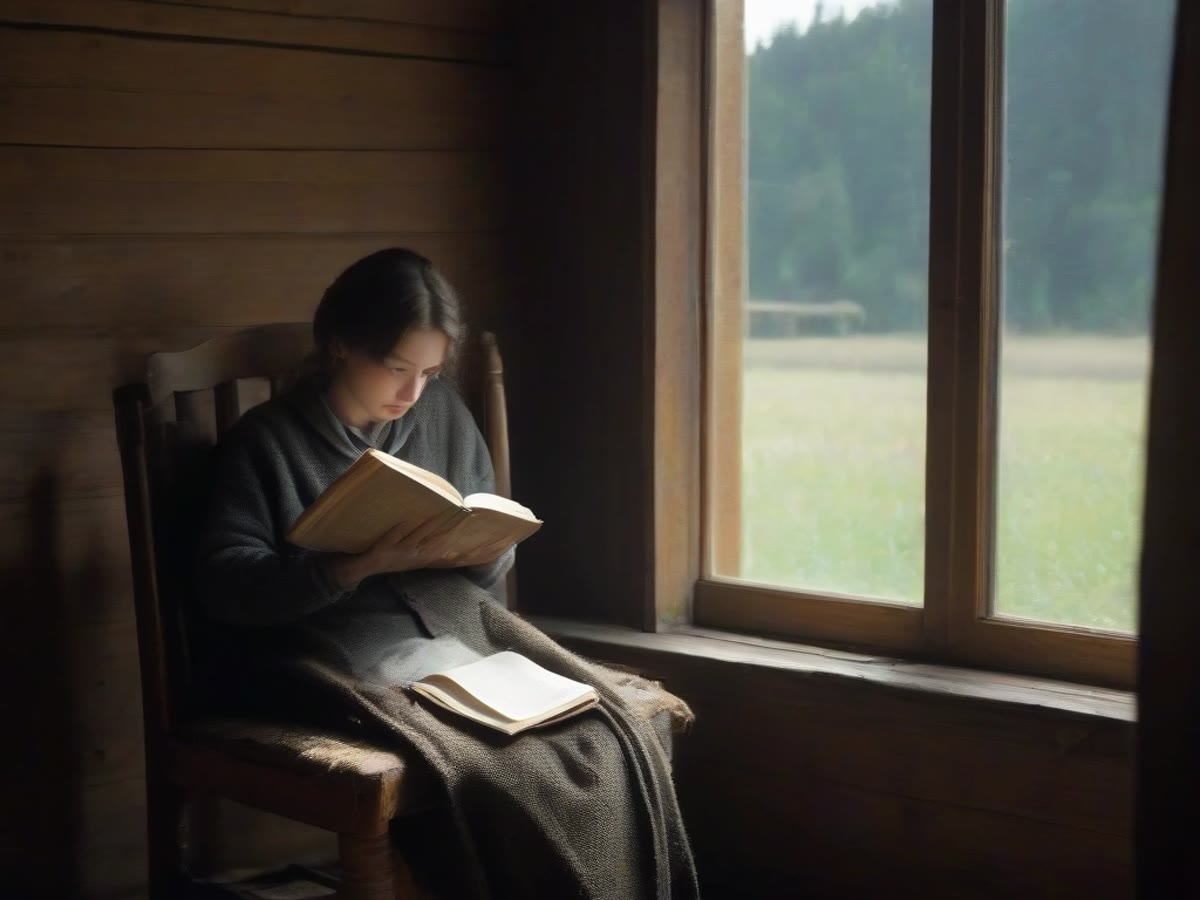
If a page of Harvey or Montaigne feels enough for a week, it is enough. This shelf is not a course. It is a way of saying that the body you live in has been wondered at for a long time, in chairs not so different from yours.
- Hippocratic writings — ancient clinical notes and reflections; history, not a prescription pad.
- William Harvey, On the Motion of the Heart and Blood — a short argument that blood goes around.
- Lucretius, On the Nature of Things — a poem about mortal matter.
- Montaigne, Essays — a person studying himself without a clinic.
- Burton, The Anatomy of Melancholy — a companion for the long weather of the mind.
- Darwin, Origin, Descent, Expression of the Emotions — kinship and faces.
- Whitman, Leaves of Grass; Thoreau, Walden; Shakespeare; the King James Bible — language for flesh and days.
- Older editions of Gray’s Anatomy — names on a map; use current care for current bodies.
Start anywhere. Stop when the light is good enough to go outside. The book will wait.
A general knowledge list for an informed human
Fifty books. Some fiction — the Odyssey is required — and more that are factual, scientific, or philosophical. Greatest writers’ main works, not a pile of commentary. Title, author, and one short clause why. Some of these works are in the public domain. Some are not. This list is a reading map, not a free library, and it carries no shop links.
- The Odyssey — Homer — a homecoming that taught later ages how to tell a long story.
- The Iliad — Homer — wrath, honour, and the cost of war.
- The Epic of Gilgamesh — anonymous — friendship and death in the oldest surviving long tale.
- Inferno, from the Divine Comedy — Dante Alighieri — a descent that mapped a moral cosmos.
- Don Quixote — Miguel de Cervantes — the novel learning to laugh at its own dreams.
- Hamlet — William Shakespeare — a mind turning on itself.
- The Death of Ivan Ilyich — Leo Tolstoy — an ordinary death, looked at without flinching.
- Crime and Punishment — Fyodor Dostoevsky — guilt as a weather the whole person lives in.
- Things Fall Apart — Chinua Achebe — a world meeting empire, told from inside.
- Moby-Dick — Herman Melville — obsession, work, and the sea as a mind.
- Republic — Plato — justice argued as if a city were a soul.
- Nicomachean Ethics — Aristotle — how a life might be well lived, in practice.
- Meditations — Marcus Aurelius — a ruler writing notes to himself on the job.
- Enchiridion — Epictetus — a short handbook on what is up to you.
- Analects — Confucius — conduct, ritual, and the repair of a person.
- Tao Te Ching — Laozi — a quiet argument against forcing the world.
- Confessions — Augustine — a life examined as memory and desire.
- Meditations on First Philosophy — René Descartes — doubt used as a tool, not a mood.
- An Enquiry Concerning Human Understanding — David Hume — what we can know, cut down to size.
- Groundwork of the Metaphysics of Morals — Immanuel Kant — duty argued from reason rather than taste.
- On Liberty — John Stuart Mill — why a person needs space to be wrong.
- Beyond Good and Evil — Friedrich Nietzsche — a hammer taken to inherited morals.
- The Human Condition — Hannah Arendt — labour, work, and action as the life of the public.
- The Wealth of Nations (selected) — Adam Smith — how exchange, labour, and markets were first seen whole.
- On the Origin of Species — Charles Darwin — kinship among living forms, argued from evidence.
- On the Motion of the Heart and Blood — William Harvey — a short proof that blood goes around.
- Six Easy Pieces — Richard Feynman — physics taught without condescension.
- Cosmos — Carl Sagan — the universe as a place a citizen might belong to.
- The Selfish Gene — Richard Dawkins — evolution retold from the gene’s point of view.
- The Double Helix — James D. Watson — how a structure of life was found, including the unflattering parts.
- The Structure of Scientific Revolutions — Thomas S. Kuhn — why science sometimes changes its whole picture.
- A Brief History of Time — Stephen Hawking — space and time for a patient general reader.
- The Body — Bill Bryson — a tour of the human animal in plain wonder.
- The Emperor of All Maladies — Siddhartha Mukherjee — cancer as a history, not only a fear.
- Being Mortal — Atul Gawande — medicine meeting aging and the end of a life.
- Silent Spring — Rachel Carson — a warning that chemicals have a public story.
- What Is Life? — Erwin Schrödinger — a physicist asking what a living thing must be.
- The Gene — Siddhartha Mukherjee — heredity as a long human story.
- Histories — Herodotus — inquiry as a way of travelling through other peoples.
- History of the Peloponnesian War — Thucydides — power, fear, and a war told without comfort.
- The Prince — Niccolò Machiavelli — politics described as it is practised.
- Democracy in America — Alexis de Tocqueville — a young republic watched by a careful stranger.
- Nineteen Eighty-Four — George Orwell — language and surveillance as a political weather.
- Understanding Media — Marshall McLuhan — how a channel changes the message it carries.
- The Language Instinct — Steven Pinker — speech as a human capacity, not a school subject only.
- Man’s Search for Meaning — Viktor E. Frankl — purpose remembered under extreme harm.
- The Second Sex — Simone de Beauvoir — what it has meant, in history, to be made a woman.
- Essays — Michel de Montaigne — a person studying himself without a clinic.
- Leviathan — Thomas Hobbes — why people make a common power, and what it costs.
- The Federalist Papers — Hamilton, Madison, and Jay — a constitution argued in public, essay by essay.